

Sports science jobs rarely show up on public job boards. Search for sports scientist jobs, and you’ll find roles that aren’t labelled that way — positions in performance analysis, strength and conditioning, or rehabilitation support.
This guide breaks down what sports scientists actually do, how people get hired, what you can realistically earn in the USA, UK, and Australia, and where the real opportunities exist in 2026.
2026 Career Snapshot
- Primary markets: USA (high growth in tactical S&C), UK (elite football and academic focus), Australia (institutional performance emphasis)
- Top certifications: CSCS (global standard), UKSCA (UK), ASCA (Australia), CPSS (performance science), BASES, ACSM
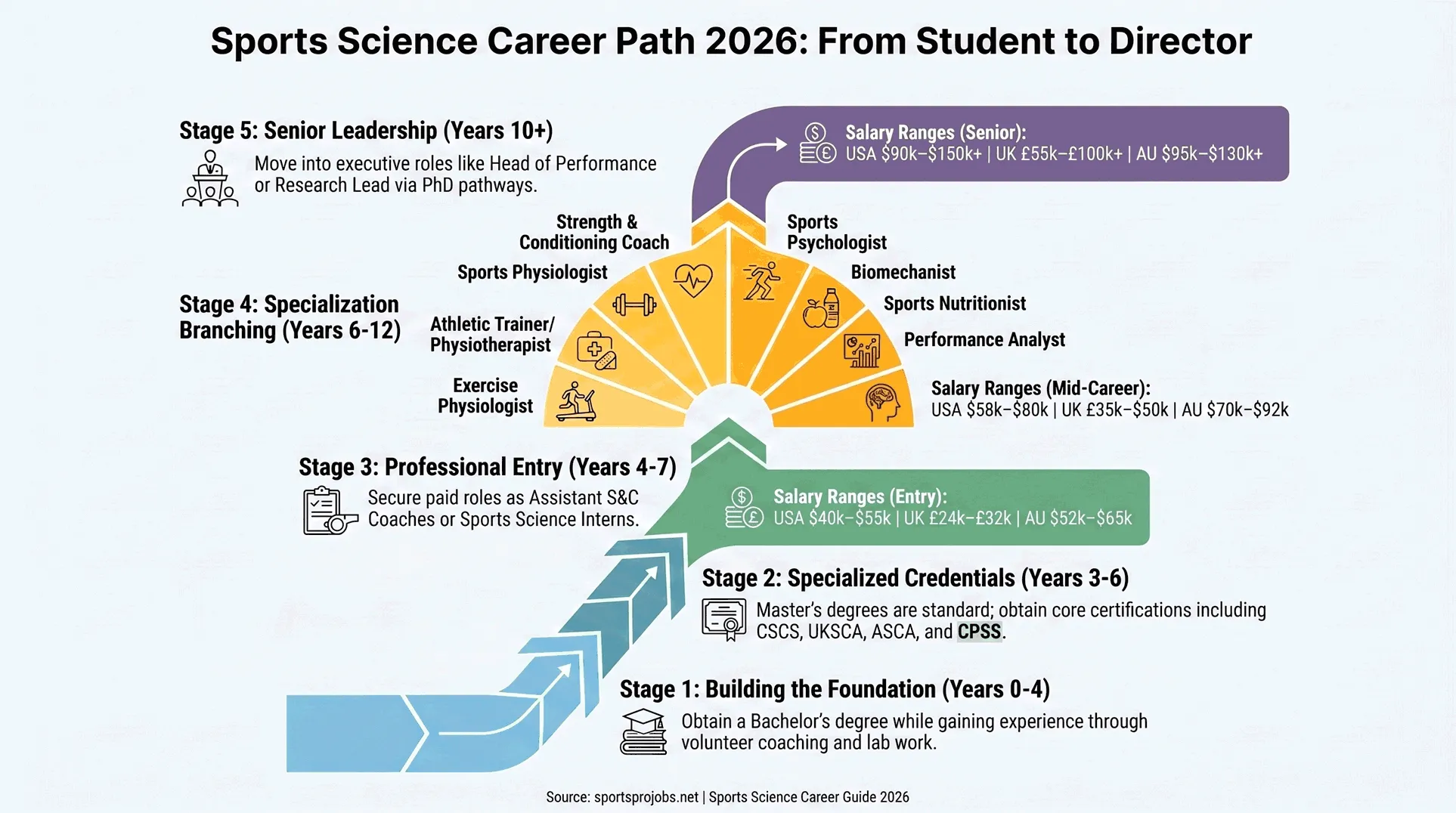
- Entry-level salary: $40,000–$55,000 USD / £24,000–£32,000 / AUD $52,000–$65,000
- Senior salary ceiling: $150,000+ for Heads of Performance in pro leagues
- Fastest-growing roles: performance analyst, sports tech specialist, tactical S&C coach
What Is a Sports Scientist?
Quick answer: A sports scientist applies physiology, biomechanics, nutrition, and psychology to improve athletic performance and reduce injury risk. In most cases, the role requires a master’s degree and involves working in professional sport, university athletics, or private performance centres.
In practice, the role sits between coaching and research. It’s practical enough to affect training decisions, yet rigorous enough to back those decisions with data. Sports scientists rarely work in isolation — instead, they operate alongside coaches, medical staff, and nutritionists as part of a performance team.
What Does a Sports Scientist Do?
Quick answer: Sports scientists collect and analyse performance data, then translate it into practical decisions coaches and athletes can act on. The work combines testing, monitoring, data analysis, and direct communication with the coaching staff.
However, the day-to-day varies significantly by setting:
- In a professional football club, it might mean tracking GPS and heart rate data across training sessions, reporting on training load, and advising on recovery protocols
- In a university athletic department, it often involves running force plate testing, supporting return-to-play decisions, and managing athlete monitoring systems
- In a private performance centre, it’s usually a mix of program design, testing, data interpretation, and direct work with coaches
- In a research institute, the focus shifts to applied studies, data analysis, and publishing findings that shape practice
That said, sports science degrees don’t always prepare you for the reality of this work. Teams tend to hire based on exposure and trust rather than textbook knowledge. As a result, how you spend your first five years in the field often matters more than which university you attended.
→ Browse current sports science jobs
Types of Sports Science Jobs
Quick answer: Sports science roles typically fall into eight specialisations: strength & conditioning coach, sports physiologist, biomechanist, sports nutritionist, performance analyst, sports psychologist, athletic trainer or physiotherapist, and exercise physiologist.
Strength & Conditioning Coach
Designs and delivers training programs for individual athletes or teams, with a focus on physical preparation, injury prevention, and in-season load management. This is the largest employer category in sports science — and also the most common entry point for graduates. To qualify, you’ll typically need a CSCS (USA), UKSCA (UK), or ASCA (Australia) accreditation along with hands-on coaching experience.
Sports Physiologist
Tests and analyses cardiovascular capacity, lactate thresholds, VO₂ max, and metabolic factors. These roles are common in Olympic training centres, national governing bodies, and elite endurance programs. As a result, they typically require a master’s or PhD in exercise physiology.
Biomechanist
Analyses movement patterns using motion capture, force plates, and video. This is one of the smallest talent pools in the field — demand consistently outpaces supply, especially at PhD level. Biomechanists work primarily in research institutes, elite sport institutes, and companies developing performance technology.
Sports Nutritionist
Designs fuelling, recovery, and hydration strategies tailored to training demands. These professionals work either with individual athletes or as part of a broader performance team. Certifications like ISSN, SENR (UK), or Sports Dietitians Australia accreditation are the standard entry requirement.
Performance Analyst
Uses video and data to break down team and individual performance — including tactical patterns, match events, and opposition analysis. This role barely existed a decade ago; now nearly every Premier League and NFL club has at least one. Strong software skills are essential, particularly Hudl, Sportscode, SQL, and Python for data-heavy roles.
Sports Psychologist
Supports mental performance, focus, motivation, and competitive strategy. Unlike other roles on this list, sports psychologists need formal licensing or registration in addition to postgraduate qualifications — for example, HCPC registration in the UK or APA certification in Australia.
Athletic Trainer / Physiotherapist
Manages injury prevention, assessment, rehabilitation, and return-to-play protocols. It’s worth noting that “Athletic Trainer” is the US-specific title (with a state licence requirement), while “physiotherapist” is the equivalent in the UK and Australia. Both paths require a bachelor’s or master’s degree plus professional registration.
Exercise Physiologist
Works across both clinical and performance contexts — from cardiac rehab and chronic disease management to athlete testing. This role bridges healthcare and sport, which means employment options are broader than for other specialisations. A bachelor’s degree is the minimum; ACSM certification (USA) or AEP registration via ESSA (Australia) is usually required.
Where Sports Scientists Work
Employers hiring sports science professionals span several sectors. Here are the main categories, roughly ordered by how competitive they are to enter:
- Professional sports teams and leagues — the highest-profile employers and also the hardest to get into
- Olympic training centres and national governing bodies — performance-focused roles that typically require formal accreditation
- University athletic departments — the largest employer category in the USA, with a strong presence in the UK and Australia as well
- Elite performance centres and training academies — a private-sector segment that’s growing rapidly
- Military and law enforcement — tactical strength and conditioning and human performance programs
- Healthcare networks and sports medicine clinics — primarily clinical exercise physiology and rehab-focused roles
- Corporate wellness and fitness programs — less common for sports scientists, but increasingly relevant in healthcare-adjacent roles
Sports Technology & Analytics Companies
In addition to traditional employers, a fast-growing category sits outside teams and universities altogether: the companies building the tools those teams use. These organisations hire sports scientists for applied research, product development, client support, and consulting roles.
Notable employers in this space include:
- Catapult Sports — GPS and athlete monitoring
- StatSports — wearable athlete tracking
- Whoop — recovery and physiological monitoring
- Hawkin Dynamics — force plate technology
- VALD — athlete assessment systems (ForceDecks, NordBord, DynaMo)
- Teamworks / Smartabase — athlete management software
- PlayerMaker, Kinexon, Zone7 — positional data and analytics
Typical roles include Sports Scientist (Client Success), Applied Research Scientist, Product Specialist, and Performance Consultant. These positions require similar qualifications to pro sport roles, but they also expect technical skills like data analytics, API work, and customer-facing communication. Salaries at senior level frequently match or exceed pro sport — without the travel and match-day demands.
How to Become a Sports Scientist
Quick answer: Becoming a sports scientist typically takes 4–7 years. You’ll need a relevant bachelor’s degree (minimum), a master’s for applied roles, specialisation-specific certifications, and 1–2 supervised internships before landing your first paid position.
Step 1 — Complete a Relevant Degree
- Bachelor’s degree — the minimum entry point. Relevant fields include exercise science, kinesiology, sports science, physiology, and biomechanics
- Master’s degree — increasingly the expected standard for applied positions. For example, athletic trainers in the USA now require a master’s from a CAATE-accredited program
- PhD — necessary for research and academic positions, and also common among senior practitioners in elite sport
Step 2 — Get the Right Certifications
Certifications matter more in some specialisations than others. That said, the following credentials consistently appear in sports science job ads:
- CSCS (Certified Strength and Conditioning Specialist) — NSCA, the USA standard for S&C roles
- UKSCA Accreditation — the UK equivalent, recognised across British pro sport
- ASCA Level 1–3 — the Australian Strength and Conditioning Association standard
- CPSS (Certified Performance and Sports Scientist) — NSCA’s newer credential aimed specifically at sports science roles
- ISSN — the international standard for sports nutritionists
- ACSM — clinical exercise physiology certification in the USA
- BASES accreditation — the British Association of Sport and Exercise Sciences credential, common in UK academia and elite sport
- NATA BOC certification — mandatory for athletic trainers in the USA
Step 3 — Complete Sports Science Internships
Sports science internships are the industry’s hidden interview. In practice, the candidates who land paid positions are almost always those who already have 1–2 supervised placements — and a large share of first paid roles come directly from internship supervisors hiring their own.
When evaluating an internship opportunity, here’s what to prioritise:
- A mentor with placement history — look for supervisors whose former interns are now in paid roles, not just a recognisable logo on your CV
- Direct exposure to athlete monitoring, testing, or data analysis — not just general team support
- Clear scope — you should know upfront what you’ll actually be doing
- A real project or case study you can include in your portfolio afterwards
It’s also worth noting that a significant portion of sports science internships remain unpaid or low-paid. This is one of the hardest realities of the field, which is why mentor selection and relationship-building during the placement matter just as much as the technical work itself.
Step 4 — Build a Portfolio
At the early-career stage, CVs tend to look similar. A portfolio is what separates you from other candidates:
- Case studies (with consent): athlete results, program design examples, and injury prevention outcomes
- Data analysis samples using tools like Excel, R, Python, or Tableau
- Technical writing — short articles or research summaries on performance topics
- Video examples of your coaching, analysis workflow, or testing protocols
Sports Scientist Salary Ranges
Salaries in sports science vary significantly by role, region, employer type, and experience level. Below are current figures for the three largest markets.
Salary by Region (2025–2026)
| Region | Entry-level | Mid-level | Senior / Head of Department |
|---|---|---|---|
| USA (USD) | $40,000–$55,000 | $58,000–$80,000 | $90,000–$150,000+ |
| UK (GBP) | £24,000–£32,000 | £35,000–£50,000 | £55,000–£100,000+ |
| Australia (AUD) | $52,000–$65,000 | $70,000–$92,000 | $95,000–$130,000+ |
Sources: U.S. Bureau of Labor Statistics (Exercise Physiologists, May 2024 data, median $58,160); Prospects.ac.uk (exercise physiologist profile); Glassdoor UK (Sports Scientist, March 2026); Glassdoor Australia and SalaryExpert (September 2025).
Salary by Role
Broad patterns emerge across the three markets:
- Sports Scientist (generalist) — mid-range in all three markets. Pro sport roles typically pay 30–50% above academic equivalents
- Strength & Conditioning Coach — pay scales sharply with level. Head S&C roles in elite pro sport reach the top of the salary range
- Performance Analyst — the highest-growth role. Data-heavy positions requiring Python or SQL command premium salaries
- Athletic Trainer / Physiotherapist — more stable across sectors due to healthcare-linked demand
- Sports Nutritionist — typically the lowest base salary. Senior roles are often freelance or consultancy-based
What Drives Salary Differences
Professional sport pays more than university positions, but the trade-off is real: contracts are shorter, job security is lower, and your position often depends on the head coach staying in post. By contrast, university roles offer more stability with a lower salary ceiling. Combination roles — where one person handles both S&C coaching and performance analysis, for example — command premium compensation because smaller organisations can’t always afford full specialist teams.
Location matters too. London, major US coastal cities, and Sydney typically pay 15–25% above national averages, although the cost of living absorbs much of that difference.
How to Get a Sports Science Job
Quick answer: The majority of sports science jobs are filled before they appear on public boards. The highest-probability entry routes are internship conversions, university alumni networks, association job boards (NSCA, UKSCA, BASES, ASCA), and direct outreach to heads of performance.
Entry Points for Graduate Sports Science Jobs
Graduate sports science jobs rarely come from cold applications. Instead, the following entry routes are far more common:
- Internship conversion — your supervisor hires you, extends your contract, or refers you to a colleague
- University alumni networks — teams and clubs often post with the master’s programs they recruit from first
- Association career boards — NSCA, NATA, UKSCA, BASES, ASCA, and ESSA all run members-only job boards with roles you won’t find elsewhere
- Direct outreach — contacting heads of performance at clubs, academies, or performance centres before a role is even advertised
- Conference networking — events like ACSM, NSCA National, and BASES Annual function as hiring opportunities as much as educational ones
Job Search Strategy
Once you’re actively searching, the following approaches tend to produce the best results:
- Apply on sports-specific job boards (including this one) rather than general career sites — you’ll get better role match and less noise
- Be willing to relocate or work internationally early in your career, since the field rewards geographic flexibility
- Consider starting with contract, part-time, or consultancy work while building toward a full-time position
- Track every application and follow up within 10–14 days if you haven’t heard back
- Treat your LinkedIn and Twitter/X presence as part of your professional profile — hiring managers do check
Why Most Sports Science Jobs Don’t Hit Public Boards
A significant share of hires happen before a role is publicly posted. Teams often already have someone in mind — usually a current intern, a referred candidate, or a known practitioner — and the public listing is essentially a formality. The practical takeaway is straightforward: networking, internships, and visibility within the field matter more than the volume of applications you submit.
Sports Science Job Market Outlook 2026
Growth in sports science employment is running ahead of the overall labour market. According to the U.S. Bureau of Labor Statistics, exercise physiologist roles are projected to grow 9% and athletic trainer roles 11% through 2034 — both well above average. The UK and Australia show similar patterns, driven by expanding professional sport budgets, university program growth, and a sharper focus on data-led performance support.
Key growth drivers include:
- Rising investment in athlete performance by pro teams and leagues
- Expansion of strength and conditioning programs at university and school level
- Fast-growing demand in sports technology, wearables, and analytics
- Increased emphasis on injury prevention and return-to-play protocols
- Tactical strength and conditioning (military, law enforcement) becoming a bigger employment category
On the other hand, entry-level sports science jobs remain highly competitive — especially in London, along the US coasts, and in major Australian cities. First paid roles often come after relocation, internship extensions, or starting in a lower-profile setting and working upward.
Sports Science Jobs by Location
Availability and pay vary significantly by region. Below is an overview of the three largest sports science markets.
Sports Science Jobs in the USA
The largest market by volume, with the highest ceiling for senior salaries. Pro sport and university athletic departments dominate the hiring landscape. Entry-level sports science jobs in the USA typically start around $40,000–$55,000, with strong career growth potential in pro franchises, NCAA programs, and the fast-growing tactical S&C sector.
Browse Sports Science Jobs in the USA →
Sports Science Jobs in the UK
Strong academic and Olympic focus, with moderate mid-career salaries and the top end driven by Premier League and high-performance sport roles. Entry-level roles in London tend to cluster in private performance centres, academies, and university research posts — typically paying £24,000–£30,000, with higher ceilings in elite pro sport.
Browse Sports Science Jobs in the UK →
Sports Science Jobs in Australia
A growing market with visa sponsorship available for qualified international candidates, and solid entry-level pay relative to the UK. Graduates can expect starting salaries around AUD $52,000–$65,000, with strong institutional support via ESSA, ASCA, and the Australian Institute of Sport network.
Browse Sports Science Jobs in Australia →
About SportsPro Jobs
SportsPro Jobs is a specialised job board focused on careers in sports performance, coaching, sports science, and athletic training. The platform connects qualified practitioners with opportunities across professional sport, university athletics, performance centres, and sports technology companies in the USA, UK, and Australia.
Our editorial team analyses hiring trends, job requirements, salary benchmarks, and career pathways in the sports performance industry. We work with established contributors and practitioners from the Complementary Training ecosystem, including strength and conditioning coaches, sports scientists, and applied researchers.
This guide reflects current 2026 data drawn from the U.S. Bureau of Labor Statistics, Prospects.ac.uk, Glassdoor, and SalaryExpert, combined with applied industry knowledge from practitioners working in professional and academic sport.
Frequently Asked Questions
What qualifications do I need for a sports science job?
A bachelor’s degree in exercise science, kinesiology, sports science, or a related field is the minimum. However, most applied roles now expect a master’s degree, and specialisation-specific certifications (such as CSCS, UKSCA, ACSM, ISSN, or BASES) are usually required as well. In the USA, athletic trainer roles also require state licensing.
How much do sports scientists earn?
At entry level, sports scientists typically earn $40,000–$55,000 in the USA, £24,000–£32,000 in the UK, and AUD $52,000–$65,000 in Australia. At the senior end, head-of-department roles in professional sport can exceed $150,000 USD, £100,000 GBP, or AUD $130,000.
What’s the difference between a sports scientist and a strength & conditioning coach?
A sports scientist focuses on testing, monitoring, and interpreting performance data. A strength and conditioning coach, by contrast, designs and delivers training on the gym floor. In smaller organisations, one person often does both. In elite sport, however, they tend to be distinct roles working alongside each other.
Can I work as a sports scientist without a master’s degree?
In support and assistant roles, yes — a bachelor’s degree plus a relevant certification is often enough. For applied sports scientist positions with professional teams or elite institutes, though, a master’s is almost always required. A PhD is common at senior level.
How do I get a sports science internship?
Most internships are filled through university program partnerships, direct applications to clubs and performance centres, and referrals from academic supervisors. It’s important to apply early — placements at high-profile organisations often fill 6–9 months in advance. Association member boards such as NSCA, BASES, and ASCA also list open internship positions throughout the year.
How competitive are sports science jobs?
Competition is high, particularly for entry-level roles in major markets. Getting hired usually requires a combination of degree, certification, internship experience, and networking. Being geographically flexible — that is, willing to relocate or work internationally early in your career — substantially expands your opportunities.
What’s the job outlook for sports scientists?
The field is growing faster than the overall job market in all three major English-speaking markets. Specifically, the BLS projects 9–11% growth for sports science–adjacent roles in the USA through 2034. Demand is strongest in performance analysis, tactical S&C, and sports technology.
Browse Sports Science Jobs
Below are current sports science job openings from across the regions we cover. Use the filters to narrow by location, role type, or experience level.
If no active listings appear below: the role you’re looking for may not be currently posted. Join our talent pool to get notified when matching positions open, or browse our USA, UK, and Australia regional pages.